Judy Bridgewater’s Songs After Dark cassette
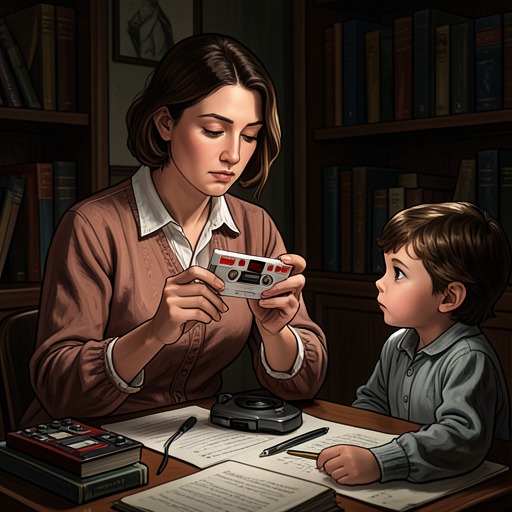
Never Let Me GoJudy Bridgewater’s Songs After Dark cassette is more than a keepsake: it carries Kathy H.’s memories from Hailsham into her adult life, and its recovery in Norfolk reveals how long Tommy has cherished the idea of finding something precious for her. The original cassette disappears during their school years; the copy they find years later cannot restore that lost object, but it becomes bound to a new afternoon shared by Kathy and Tommy. The tape’s changing meanings—from private possession, to absence, to a gift and a record of companionship—make it a small, durable vessel for their past.
Identity and History
At Hailsham, the cassette is Kathy’s favourite tape and one of her most valued possessions. The album is called Songs After Dark. Kathy remembers that the original had turned up at one of the school’s Sales, and that she lost it there; who took it, or what became of it, remains unknown. The loss matters beyond the object’s price or rarity: Ruth knows how upset Kathy is, and the tape becomes a wish that can be carried forward even after the original has vanished.
Years later, Kathy clarifies that the cassette she still owns is not the one she lost at Hailsham. It is a replacement that she and Tommy found in Norfolk. That distinction gives the object two histories: one attached to childhood and disappearance, and another to the search, discovery, and adult relationship that brought a copy back into Kathy’s hands. The second cassette does not prove that the first was ever recovered; it answers the loss by creating a different object with its own memories.
Loss and Tommy’s Long Search
The original cassette’s disappearance becomes important to Tommy through Ruth’s account of Kathy’s distress. He remembers Ruth encouraging people to look for it, and he himself searches places he thinks Kathy cannot access, including the boys’ dormitories. He looks for a long time without success and does not tell Kathy that he has tried. His search is therefore not a single gesture made during their later trip, but a private effort that began back at Hailsham and continued in his imagination after the tape could not be found.
Tommy holds on to the possibility of making the discovery himself. He imagines finding the tape and bringing it back to Kathy, rehearsing her response and the moment of giving it to her. When he later sees records and tapes in a Norfolk shop, he admits that he has been looking for her lost cassette, although he can no longer remember its title accurately. Kathy supplies the name, Songs After Dark, while Tommy concludes that the shop does not have it. His error of memory underscores the distance between the original loss and the later search: what persists most clearly is not the album’s name, but his desire to find it for her.
The Norfolk Discovery
Kathy and Tommy’s search takes place amid second-hand shops stocked with unrelated goods: creased paperbacks, postcards, trinkets, clothes, and boxes of records and cassettes. They initially enter the wrong kinds of stores, then find several shops close together that have the boxes they want. The shared rummaging becomes enjoyable in its own right, and for a while the search for the particular tape recedes behind their pleasure in browsing together.
Kathy finds the replacement while flicking through cassette cases. Its cover is immediately recognizable: the singer, her cigarette, her coquettish glance towards a barman, and blurred palm trees in the background. Yet the discovery does not produce uncomplicated delight. Kathy stands still, hesitates to call Tommy over, and briefly considers pretending she has not seen it. The tape has been an excuse for the outing, and finding it seems to threaten the end of their carefree search. The case also feels faintly embarrassing to her, as though it belongs to a younger self. Only after the initial pause does she summon Tommy and show him what she has found.
Tommy asks whether it could be the very cassette Kathy lost, but the discovery does not establish that it is. He is not the person who spots it, and his subdued reaction reflects the failure of the particular scene he had imagined: he had wanted to find the lost tape himself and give it to her. He nevertheless buys it for her. His purchase turns the replacement into a gift, while the actual recovery remains Kathy’s discovery. The old shopkeeper has to find the cassette to go with the case, completing the purchase without resolving the uncertainty about the original.
Gift, Memory, and Shared Meaning
After the purchase, Kathy feels regret that the tape has appeared so quickly, and Tommy remains lost in thought when she tries to restore their earlier joking mood. Later, back at the Cottages and alone in her room, she appreciates having the tape and its song again. Its meaning is not confined to Hailsham: when she looks at the cassette in later life, it recalls the Norfolk afternoon as much as the school days. The replacement therefore preserves more than a likeness of the lost object; it holds the memory of searching with Tommy and of learning what he had quietly tried to do for her.
The conversation between them makes the difference between finding and being found especially clear. Tommy wishes he had been the one to discover the cassette, because he had imagined for years what that would mean. Kathy, in turn, tells him that the outing happened because he suggested looking for it and later thanks him for buying it. The exchange gives the tape a shared significance without erasing the asymmetry of their memories: Tommy remembers the unfulfilled fantasy of returning the original, while Kathy comes to value the real, imperfect recovery and the afternoon attached to it.
Ruth also encounters the replacement when she finds it among the cassettes in Kathy’s room. Kathy explains that she and Tommy found it in Norfolk, and Ruth identifies Tommy as the one who found it for her. Kathy corrects her: she was the one who saw it first. This small dispute preserves the precise division of their actions, while Ruth’s response shows that the tape remains connected to the relationships among all three friends. The object can prompt recollection, but those recollections are not identical or automatically shared; each person’s understanding of its recovery reflects a different place in the story.
Later Life and Significance
In her later account, Kathy still calls the cassette one of her most precious possessions. She sometimes listens to it while driving through the open countryside, although a faulty tape machine in her car makes her reluctant to use it there, and she rarely has enough time to play it at home. Her attachment thus persists even when practical circumstances limit her access to the music. The object remains present both as something she can handle and as a memory-bearing possession whose value does not depend on constant use.
Kathy’s recollections of the cassette sit within a larger act of looking back as her time as a carer approaches its end. She recognizes that the later events involving Tommy and Ruth grew out of their Hailsham years, and that old memories have become newly important as she prepares for a change in pace. The tape makes this movement tangible: its first loss belongs to school, its replacement to the adult journey to Norfolk, and its later presence to Kathy’s private remembrance. Like other memories of Hailsham, it helps sustain a connection to a past that cannot be revisited in its original form. When Kathy insists that her memories of Ruth and Tommy will not be lost, the cassette stands as one concrete object through which those relationships remain available to her.